If you are a marketing manager, communications lead, founder, or agency commissioning a business video, the confusing part is often everything that happens between approving the idea and receiving the finished file. Who writes the script? When do you need to supply brand assets? How long should editing take? And why can a one-day shoot turn into a project lasting several weeks? Understanding the corporate video production process before work begins helps you plan approvals, avoid costly late changes, and set a realistic launch date. Scarlet Production supports end-to-end corporate video production, from planning and filming through post-production and delivery.
At its simplest, the video production process has three core stages: pre-production, production, and post-production. In practice, there is also an important step before those stages: agreeing on a clear brief and scope.
For many standard corporate videos, a useful planning window is roughly three to eight weeks, although simple projects can be faster and complex ones can take longer. Filming itself is often one of the shortest parts. Scheduling, scripting, approvals, editing, graphics, and revisions usually have a greater influence on delivery time.
Before Anything Is Filmed: The Brief
A corporate video does not start with a camera. It starts with defining what the video needs to achieve.
A useful brief should answer:
- What is the main objective?
- Who is the audience?
- Where will the video be used?
- What should viewers do or understand afterwards?
- What approximate runtime is required?
- Which messages or brand elements must appear?
- Which final versions are needed?
- Who has final approval?
The format matters too. A company profile, recruitment film, product demonstration, executive interview, training video, and animated explainer all require different production plans.
If the format is still undecided, reviewing the main types of corporate video can help clarify what the production needs to involve.
A vague brief usually creates problems later. Imagine a hypothetical software company asking for a two-minute video that will “make the brand look innovative.” Is it aimed at customers, investors, or job candidates? Will it be used on a website, LinkedIn, or at an event? Should innovation be shown through interviews, product footage, or animation?
If those questions are still unresolved during editing, the team may have filmed material for the wrong kind of video.
Stage One: Pre-Production
Pre-production turns the brief into a practical filming plan.
For a straightforward corporate project, this phase may take roughly one to three weeks. More complicated concepts, casting, multiple locations, animation, permits, or slow stakeholder approvals can extend it.
Concept and treatment
The concept establishes the main creative idea. The treatment develops that idea into a clearer picture of the finished film.
Depending on the project, it may cover:
- Story structure
- Visual style
- Camera approach
- Interview format
- Locations
- Music direction
- Graphics or animation
- Overall tone
This is where the client and production team confirm they are imagining the same type of finished video.
These decisions also affect what shapes the budget, because additional locations, shoot days, specialist crew, talent, equipment, and post-production increase the scope.
Scripting and sign-off
Not every corporate video needs a word-for-word script. Some rely on interview questions, talking points, voiceover, or a mixture of scripted and unscripted material.
Whatever the format, the core messaging should be approved before filming.
One common problem is committee scripting, where several stakeholders make separate edits and create conflicting feedback. A more efficient approach is to nominate one person to collect and consolidate comments before they are returned to the production team.
Major script changes after filming can require new voiceover, revised graphics, a restructured edit, or even another shoot.
Casting, locations, and scheduling
Once the concept is approved, logistical planning begins.
This can include:
- Selecting interview participants
- Casting professional talent where required
- Confirming locations
- Checking access and permissions
- Creating shot lists or storyboards
- Scheduling crew and equipment
- Planning lighting and sound
- Preparing call sheets
- Organising props, wardrobe, or transport
- Arranging permits where required
Corporate filming often has to work around normal business operations. Offices may still be in use, factories may have safety restrictions, and senior staff may only be available for a short period.
What clients need to supply
Depending on the project, the production team may need:
- Brand guidelines
- Logos
- Approved product information
- Existing photos or footage
- Names and job titles
- Interviewee availability
- Legal wording
- Location access details
- Diagrams or presentation material
- Translated copy
Late assets can delay editing, especially if graphics or subtitles need to be rebuilt after earlier versions have already been approved.
Stage Two: The Shoot
Production is where the planned footage is captured.
Many corporate projects require one or a few filming days, although multi-location shoots, larger casts, complex setups, or specialist equipment can extend the schedule.
What a corporate shoot day looks like
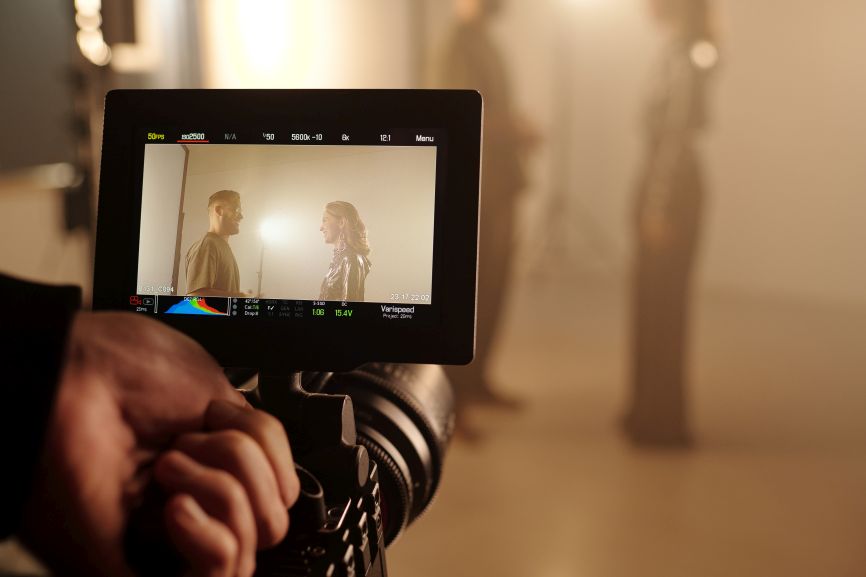
The crew usually arrives before the people appearing on camera so lighting, sound, and camera setups can be prepared.
A typical day may include:
- Technical setup
- Sound and lighting checks
- Interviews or scripted scenes
- Additional takes
- B-roll
- Workplace, product, or process footage
- Pick-up shots
- Equipment breakdown
B-roll is particularly important for interview-driven videos. If someone talks about manufacturing, technology, customer service, or company culture, supporting footage gives the editor something meaningful to show instead of holding on the same speaker throughout.
Who is on set?
Crew size depends on the brief.
Possible roles include a producer, director, director of photography, camera operator, sound recordist, lighting crew, production assistant, stylist, hair and makeup artist, or drone operator.
A straightforward executive interview can use a compact crew. A scripted brand film may require substantially more people and equipment.
Corporate shoots can also differ from advertising productions because they frequently need to work around functioning workplaces and non-professional on-camera participants. For a closer comparison, see how a TV commercial shoot differs. Readers interested in the advertising workflow can also explore how TV commercials get made.
Interview-based versus scripted shoots
Interview-led production allows participants to answer naturally rather than memorising every line. The strongest responses are then shaped during editing.
This can feel more authentic, but interviews are less predictable. Non-professional participants may need more time and direction once cameras are rolling.
Scripted production gives greater control over exact wording, which can be useful when technical accuracy, compliance language, or precise messaging matters.
Neither approach is automatically better. The objective should determine the format.

Stage Three: Post-Production
Post-production begins after filming and includes editing, sound work, colour correction or grading, graphics, subtitles, effects, and final delivery.
A straightforward edit may take several days. More involved projects can take several weeks, especially when animation, multiple deliverables, translations, or lengthy approval cycles are involved.
Assembly and first cut
Editors first organise the footage and build the structure.
For interview-based projects, this can involve reviewing a large amount of recorded conversation to find the strongest statements and create a concise story.
The first cut commonly establishes:
- Story structure
- Interview selections
- Scene order
- Pacing
- B-roll placement
- Approximate runtime
Feedback at this stage should focus mainly on whether the story and message are working.
The revision process
There is no universal number of revision rounds, but many production agreements use a defined number of structured review stages.
A sensible sequence might be:
First review: structure, message, missing material, major changes.
Second review: shots, wording, graphics, pacing, and music.
Final review: names, spelling, subtitles, or export corrections.
Defined rounds can be more useful than an open-ended revision process because they encourage stakeholders to review properly and consolidate feedback.
Colour, sound, graphics, and subtitles
Finishing work can include:
- Colour correction and grading
- Dialogue cleanup
- Sound mixing
- Music
- Titles and lower thirds
- Motion graphics
- Logo animation
- Visual effects
- Subtitles
- Translation
The exact order varies by project and workflow.
Versioning and delivery formats
One project may need several versions, such as:
- Landscape master
- Vertical social edit
- Short cutdowns
- Captioned versions
- Versions without text
- Different language versions
- Event-screen exports
These should ideally be identified during briefing. Different platforms and placements use different aspect ratios and viewing environments, so planning deliverables before filming makes framing and graphics easier later.
How Long Does a Corporate Video Take?
A useful planning range for many corporate video projects is around three to eight weeks from briefing to final delivery, although there is no universal corporate video production timeline.
A practical guide is:
| Stage | Indicative Planning Range |
| Brief and discovery | A few days to 1 week |
| Pre-production | 1 to 3 weeks |
| Production | Often 1 to a few shoot days |
| Editing and post-production | 1 to 3+ weeks |
| Revisions and delivery | Several days to 2+ weeks |
| Overall project | Often around 3 to 8+ weeks |
These are broad planning ranges, not guaranteed Scarlet Production turnaround times.
Projects may take longer because of:
- Multiple locations
- Animation or complex graphics
- Numerous deliverables
- Multilingual versions
- Participant availability
- Permits
- Delayed approvals
- Conflicting feedback
- Major changes after sign-off
Many of these factors also influence what shapes the budget.
If the video has a fixed launch date, work backwards from that date and include time for internal approvals.
Where Corporate Video Projects Go Wrong
The biggest problems are often decision-making problems rather than technical ones.
Too many people rewrite the script
Stakeholder input is useful, but separate and conflicting edits create delays. Nominate one person to consolidate feedback.
The objective changes halfway through
A recruitment film cannot suddenly become a product launch video without affecting the footage, edit, graphics, and possibly the shoot itself.
Nobody planned distribution
A landscape video is not automatically suitable for every social placement. Decide where the content will be used before filming.
Nobody knows who can approve the work
“Everyone needs to see it” is not an approval workflow. Identify who can sign off the script, rough cut, factual information, and final delivery.
Assets arrive late
Logos, translations, diagrams, legal wording, product screens, and employee information can all become production dependencies. Give client-supplied assets deadlines of their own.
Producing Corporate Video Remotely
International clients do not necessarily need to attend every stage in person.
A remote workflow can include:
- Video calls during creative development
- Digital script and treatment approvals
- Shared schedules
- Remote shoot review where practical
- Online review files
- Time-coded feedback
- Consolidated revision notes
- Approval workflows across time zones
- Remote final delivery
For a Bangkok production involving an overseas brand or agency, clear decision-making matters more than physical distance.
Agree in advance who can approve each stage, when feedback is due, and which time zone applies to deadlines. Multilingual projects should also have an authorised reviewer for each language so corrections arrive in one consolidated set.
FAQ
How long does it take to produce a corporate video?
Many standard projects can be planned across roughly three to eight weeks. Simple interview-led videos may be faster, while multi-location filming, animation, complex graphics, or slow approvals can extend the timeline.
What are the main corporate video production steps?
The main steps are briefing, pre-production, production, post-production, client review, finishing, and delivery.
What happens during the pre production process?
The pre production process turns the approved idea into a practical filming plan. It can include concept development, scripting, storyboards, shot lists, locations, talent, permits, crew, equipment, logistics, and scheduling.
How many revisions are normal for a corporate video?
There is no universal number. Many projects use a defined number of structured review rounds, so the exact allowance should be agreed before production begins.
Do I need to be on set?
Not necessarily. An authorised client representative can be useful when immediate decisions are required, but remote approval workflows can also work effectively.
Can the corporate video production timeline be shortened?
Sometimes. A clear brief, available locations and participants, fast approvals, one decision-maker, and limited deliverables can help a project move more quickly. Rushing pre-production before key decisions are made can create delays later.
Plan the Process Before You Plan the Shoot
A successful corporate video production process depends on much more than the day the camera arrives.
A clear objective makes scripting easier. An approved script makes production easier to schedule. Good pre-production helps the crew capture the footage the editor needs. Structured feedback prevents revisions from becoming an endless cycle. And agreeing on delivery formats early ensures the finished content is designed for where people will actually watch it.
If you are planning a project in Thailand or coordinating production from overseas, talk to Scarlet Production about its corporate video production services and the production structure your brief will require.